

Table of Contents
When it comes measuring temperature accurately, do you ever find yourself wondering how devices determine heat and cold so precisely? Specifically, when it’s related to healthcare, industrial processes, or scientific experiments where temperature measurement is critical.
The answer to this lies in thermal probes, which are tools designed specifically to sense and measure temperature with maximum accuracy. These devices are crucial components in many industries whether it’s ensuring safety in manufacturing or accurate medical diagnoses.
But this isn’t only about these thermal probes, there is so much more for you to explore. From what they actually are, how they work, their types, accuracy, and calibration to benefits and limitations, this article will cover everything. Keep reading to uncover everything.

What is a Thermal Probe?
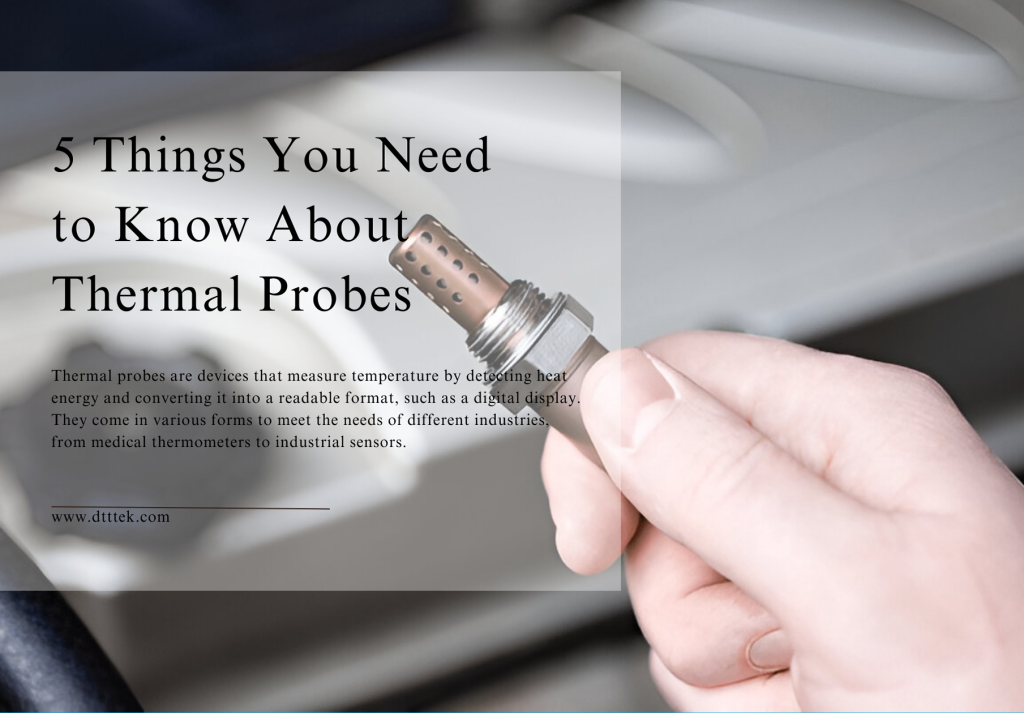
Before diving into its details, let’s briefly look at what this device actually is. Thermal probes are devices that measure temperature by detecting heat energy and converting it into a readable format, such as a digital display. They come in various forms to meet the needs of different industries, from medical thermometers to industrial sensors. Their primary purpose remains the same in various environments which is to provide precise and real-time temperature.
5 Things You Need to Know About Thermal Probes
At first, when you hear about these devices you might feel overwhelmed because it sounds like something complex. However, understanding thermal probe functionality, accuracy, types, benefits, and common uses will make everything much clearer.
Here are 5 things to know about these devices:
How Thermal Probes Work?
Every device at a certain temperature threshold can malfunction or be damaged. But can we do anything to prevent it when we don’t know the current temperature? That’s where thermal probes come in handy. These probes react to heat energy in their surroundings, as a result when the temperature changes it gets detected and the sensor produces a tiny electrical signal. This signal is then processed by the probe to display the exact temperature on the screen.
Technology Behind Thermal Probes
The technology behind these thermal probes can vary by type. Most commonly it includes thermocouples, resistance temperature detectors (RTDs), or infrared sensors. These components work together to provide reliable readings.
The Role of Sensors
Sensors are the crucial components of thermal probes. They are the reason behind precise and consistent measurements because they even detect the smallest temperature changes.
Types of Thermal Probes and Their Uses
Thermal probes come as contact probes and non-contact probes. They are categorized based on how they measure the temperature. Choosing the right type depends on your needs such as the level of accuracy required or whether direct contact with the object is feasible. Here is a brief comparison of these two.
| Aspect | Contact Probes | Non-Contact Probes |
| Measurement Method | Requires direct physical contact with the surface or medium | Measures temperature from a distance using infrared technology |
| Use Cases | Common in food safety, manufacturing, and industrial machinery | Ideal for hazardous environments, moving objects, or when hygiene is critical |
| Accuracy | Provides precise temperature readings | May be less accurate, depending on the object and distance |
| Environment | Suitable for environments where direct contact is safe or feasible | Useful in environments where direct contact is unsafe or impractical |
| Advantages | High accuracy, reliable in controlled settings | Can measure without touching, reducing contamination risk |
| Limitations | Limited to static or accessible surfaces, requires proximity | Can be affected by environmental factors like dust or humidity |
Accuracy and Calibration Considerations
Getting accurate temperature readings is non-negotiable because even small errors can cause problems in critical tasks. Such as in healthcare where incorrect reading means a wrong diagnosis.
Importance of Accuracy
Accuracy simply put is all about how close the temperature reading is to the actual temperature. Thus, when a thermal probe provides accurate results, it ensures safety, quality, and efficiency in its application. For example, a food processing company will rely on precise temperatures to ensure food is cooked properly or stored correctly without causing any health risks.
Factors That Can Affect Accuracy
- Environmental Conditions: Dust, humidity, and sudden temperature changes can affect how well a probe works.
- Improper Use: Using the probe in a wrong way like placing it incorrectly or exposing it to conditions it’s not meant for, can lead to inaccurate readings.
- Wear and Tear: Over time when the thermal probe ages, its parts like the sensors can degrade which reduces its accuracy.
- Calibration Issues: Calibration is the reason behind the probe’s accurate readings. If it isn’t calibrated regularly, its measurements may drift away from the true value.
Benefits & Limitations
Thermal probes come with advantages that make them very useful in various fields. However, they also have some limitations, here is a breakdown of both:
Benefits
- High Accuracy: Thermal probes are designed to be precise for temperature measurements. This makes them handy in fields where slight temperature variations can be detrimental.
- Versatility: What makes them best is their versatility which suits different needs. You can use them in healthcare and research or in food processing. For example, they can let you know a patient’s body temperature and they can also control over temperature in baking.
- Real-Time Monitoring: One of the major advantages of these devices is their ability to provide instant temperature readings. This is crucial in time-sensitive processes such as monitoring equipment in industrial operations.
- Durability and Longevity: Thermal probes are designed to withstand tough conditions such as high heat, heavy use, or corrosive environments. This makes them ideal for industries like chemical production and metalworking.
- Ease of Use: Modern-day thermal probes are designed to be user-friendly, even someone without technical know-how can operate them with simple instructions.
- Customizable Options: With various types of probes available like contact, non-contact, rigid, or flexible, you can select the one that meets your needs.
Limitations
- Environmental Sensitivity: While these devices are versatile, extreme conditions like high humidity or dust might affect their accuracy and performance.
- Regular Calibration Required: Thermal probes need to be calibrated periodically for accuracy. This may be a time-consuming process in some industries.
- Compatibility Requirements: Some thermal probes are compatible with only certain types of devices.
Industries that use Thermal Probes
Thermal probes are used in different industries and their applications span across different sectors, all this due to their precision and versatility. Below are some key industries where these devices play an important role.
Healthcare
Thermal probes are important in healthcare, particularly in patient care. A study titled “Temperature Management in Intensive Care Unit” which was a practical survey from China emphasizes its importance. It shows temperature measurement methods such as bladder temperature monitoring to enhance patient outcomes. Consistent and precise temperature tracking ensures effective treatment.
Industrial
In industrial settings, thermal probes monitor machinery and processes to prevent overheating. For example, in steel production, they measure molten metal temperatures that exceed 1,500°C to optimize casting quality. Similarly, food processing ensures foods are cooked and stored at safe temperatures and the requirements of FDA standards.
Research
Thermal probes are also useful for research purposes. For instance, environmental studies can be used to measure sea and soil temperatures to track climate changes. While in laboratories they maintain precise conditions for biological conditions.
How to Choose the Right Thermal Probe for Your Needs
To select the right thermal probes for your needs, you need to have certain key considerations in mind. Here are some of the main ones:
- Measurement Environment: Determine where you will be using the probe. For example, industrial processes may require probes resistant to high temperatures. While outdoor applications need weather-resistant probes.
- Temperature Range: You should choose a probe that accurately measures within a specific temperature range of your application. Example ranges include:
- Type K Thermocouple: -270°C to 1372°C
- Thermistors:-55°C to 125°C
- RTDs: -200°C to 850°C
- Accuracy Requirements: Some applications demand precise readings like medical monitoring while others like industrial monitoring can tolerate slight deviations. Here are some examples of accuracy requirements in these fields:
- Medical Monitoring:Probes must be accurate within 0.1°C specifically the ones used for patient temperature monitoring.
- Industrial Monitoring: A tolerance of ±2°C might be acceptable when monitoring furnace temperatures.
- Response Time: Consider how quickly the probe needs to provide readings. Fast-response probes are best for applications that experience sudden temperature changes. Here are the options you choose considering the response time:
- Type K Thermocouples: These devices respond within 0.1 second which makes them suitable for high-speed processes.
- Thermistors: These have a response time in the range of 1 – 3 seconds which makes them ideal for more stable environments.
- Durability and Material: Make sure the probe-built material is suitable for your operating conditions.
- Calibration Needs: Check if the probe requires regular calibration and then ensure you have access to calibration services or kits to maintain accuracy.
- Compatibility with Equipment: Make sure the probe is compatible with your existing equipment.
Conclusion
Without thermal probes measuring temperature accurately and efficiently in different applications becomes challenging. They bridge the gap between complex processes and precise monitoring. This is why they are very useful in healthcare, manufacturing, and research as discussed above.
The value of these products lies in their ability to deliver accurate temperature readings. Whether you are a manufacturer, or a food processing company, without thermal probes you can’t maintain quality standards or ensure safety.
Thermal probes are definitely useful but to make sure they work efficiently, you need to get them from a reputed provider. Considering this, you can choose DTTTEK which is committed to providing high-quality and reliable thermal probes that effectively meet your industry needs. Contact professionals now for all your temperature-sensing requirements.
 English
  Español
  العربية
  Deutsch
  Português do Brasil
  한국어
한국어