

Table of Contents
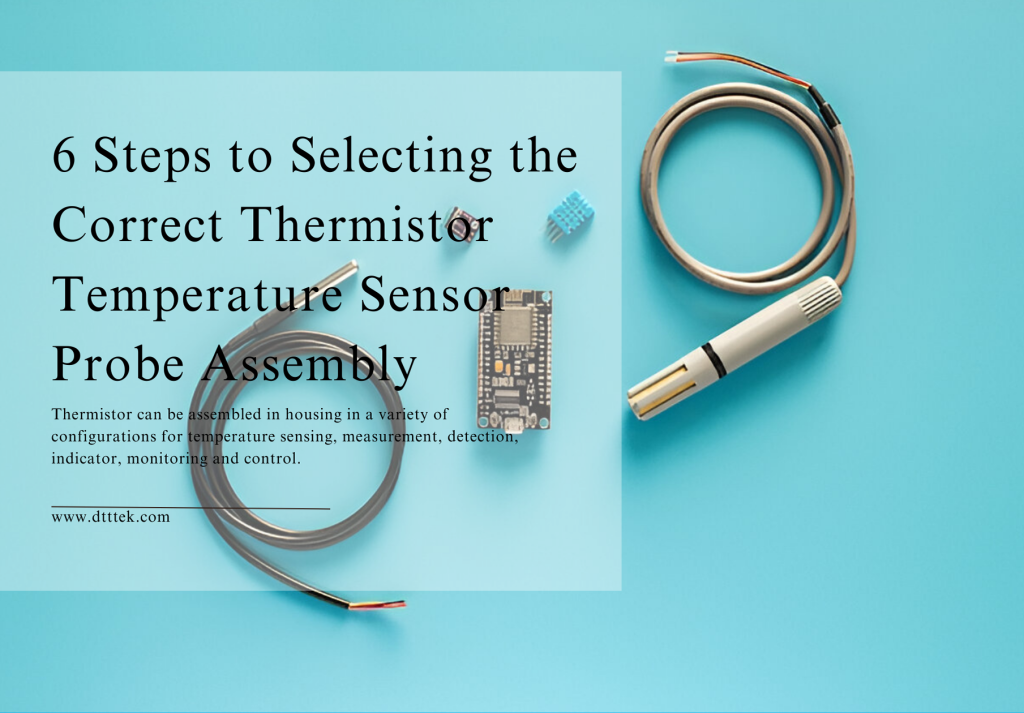
When we use temperature sensors, we mostly use them directly. What I mean is that, whether it’s a thermistor or a temperature probe, we probably think of using them separately. But in reality, we can assemble thermistors in a variety of configurations for temperature sensing, measuring, detecting, indicating, monitoring, and controlling.. These assemblies can be easily connected to or be an integral part of any system to monitor or control temperature.
The choice of assembly depends on the application. The main factors that determine the optimum configuration of a thermistor assembly are operating environment, mounting, time response and minimum dissipation constant. Both time constants and dissipation constants vary with the thermistor and enclosure selected. The heat transfer characteristics of the enclosure, thermistor location, mass, and wire type determine these constants.
Given the wide variety of thermistor probe components available, choosing the right one can be overwhelming. This guide will walk you through six basic steps to help you select the correct thermistor temperature sensor probe assembly for your project or application.

Step 1: Understand the Application and Measurement Range
Before diving into specific thermistor characteristics, the first critical step is to assess the application and measurement range required for the sensor. This step sets the foundation for the entire selection process.
Application Context
The application determines the type of sensor needed based on environmental conditions, the temperature range, and the sensor’s specific function. Thermistors are used in various applications, each with unique demands. These include:
- HVAC Systems: Accurate temperature monitoring is essential for efficient heating, ventilation, and air conditioning.
- Medical Devices: People commonly use thermistors in medical thermometers and incubators, where precise temperature control is critical.
- Automotive Sensors: Thermistors are widely used in engine control systems and battery monitoring.
- Consumer Electronics: Devices like refrigerators, air conditioners, and ovens rely on thermistor sensors for temperature regulation.
Temperature Range
The temperature range of the thermistor sensor probe assembly is a fundamental factor in your selection process. Manufacturers create different thermistors to function optimally within certain temperature ranges, and selecting a sensor outside this range can lead to faulty readings or premature failure. For example:
NTC Thermistors: The resistance of NTC thermistors decreases with rising temperature, making them ideal for a broad range of applications. The typical temperature range for NTC thermistors is between -50°C and 150°C, though specialized versions can withstand extreme conditions, such as -100°C to 300°C or more.
High-Temperature Thermistors: In certain high-temperature industrial applications, thermistors rated for temperatures as high as 600°C or 1000°C are used. These thermistors are critical for temperature measurement in furnaces, metal processing, and aerospace applications. For example, analysts forecast the high-temperature sensor market within the automotive and aerospace sectors will grow at a CAGR of 9.2% from 2021 to 2028.
2. Probe Housing Design, Assembly Dimensions, and Cable Requirements
Surface temperature sensors are carefully designed to conform to the shape of the surface they measure, whether it is flat, curved, or cylindrical. These sensors often include mounting holes or clips to simplify installation. The most common method for surface measurement uses a ring lug, as the small size of the thermistor allows it to fit into most ring lug barrels.
Probe Material
The choice of housing material depends on a variety of factors, including the required temperature range, response time, cost, and any specific regulations (such as UL, FDA, or NSF standards) used in food or medical applications.
Common probe materials include:
- Stainless steel: Corrosion-resistant, durable, and suitable for a variety of applications such as industrial and automotive.
- Plastic: It’s lightweight, cost-effective, and works well in low-temperature environments or where flexibility is required.
- Ceramic: Has high thermal stability and is often used in high-temperature environments.
- Glass: Used for high-precision, low-temperature measurements, especially in medical devices.
Make sure to choose a material that can withstand the environmental conditions the sensor will face, such as chemical exposure, moisture, or extreme temperatures.
Probe Shape and Size
The probe size and shape are also important. For example, a long, slender probe may be ideal for monitoring fluid temperature, while a short, compact probe may be better for measuring surface temperature. Design the probe to fit the available space in the application. If you need to insert the sensor into a narrow space, consider the size of the probe as well.
Step 3: Determine the Desired Thermistor Type (NTC vs. PTC)
Once you have a good understanding of the application and temperature range, the next step is to choose the correct thermistor type: NTC (Negative Temperature Coefficient) or PTC (Positive Temperature Coefficient).
NTC Thermistors
NTC thermistors are the most commonly used type in temperature sensing applications. They have a negative temperature coefficient, meaning their resistance decreases as the temperature increases. This property makes them ideal for applications that require precise temperature measurements over a wide range.
NTC thermistors are typically used in applications like:
- Temperature regulation systems (e.g., refrigerators, air conditioners)
- Battery management systems
- Power supply and circuit protection
PTC Thermistors
PTC thermistors, on the other hand, have a positive temperature coefficient, meaning their resistance increases as temperature rises. These thermistors are less common for regular temperature sensing but are used in specific applications, particularly where overcurrent protection is necessary.
PTC thermistors are commonly found in applications like:
- Overcurrent protection circuits
- Heaters (to limit temperature rise)
- Self-regulating heating elements
The decision between NTC and PTC will depend largely on whether you need the sensor for temperature monitoring (NTC) or overcurrent/overheat protection (PTC).
Step 4: Assess Accuracy and Tolerance Requirements
People favor thermistors for their accuracy, but it’s important to understand the accuracy and tolerance required for your application. This step will help you determine how precise your thermistor needs to be in providing temperature readings.
Accuracy
The accuracy of a thermistor is usually expressed in terms of the deviation from the actual temperature, typically in degrees Celsius (°C). Some applications, like industrial processes or medical devices, may require high-precision sensors, while others may tolerate slight variations.
In high-precision settings, such as medical thermometers or laboratory equipment, you’ll need a thermistor with an accuracy of ±0.1°C or better. For general industrial or HVAC applications, an accuracy of ±1°C might be sufficient.
Tolerance
Tolerance refers to the allowable error or deviation in the thermistor’s resistance measurement over a given temperature range. A sensor with a low tolerance will provide more consistent readings, making it ideal for applications where precision is critical. However, sensors with lower tolerance are often more expensive.
When assessing tolerance, keep in mind that a thermistor’s resistance is temperature-dependent, and small changes in resistance can lead to large variations in temperature readings. Always match the tolerance with the sensitivity required for your system to avoid measurement errors.
Step5: Assess Accuracy and Tolerance Requirements
Thermistors are favored for their accuracy, but it’s important to understand the accuracy and tolerance required for your application. This step will help you determine how precise your thermistor needs to be in providing temperature readings.
Accuracy
The accuracy of a thermistor is usually expressed in terms of the deviation from the actual temperature, typically in degrees Celsius (°C). Some applications, like industrial processes or medical devices, may require high-precision sensors, while others may tolerate slight variations.
In high-precision settings, such as medical thermometers or laboratory equipment, you’ll need a thermistor with an accuracy of ±0.1°C or better. For general industrial or HVAC applications, an accuracy of ±1°C might be sufficient.
Tolerance
Tolerance refers to the allowable error or deviation in the thermistor’s resistance measurement over a given temperature range. A sensor with a low tolerance will provide more consistent readings, making it ideal for applications where precision is critical. However, sensors with lower tolerance are often more expensive.
When assessing tolerance, keep in mind that a thermistor’s resistance is temperature-dependent, and small changes in resistance can lead to large variations in temperature readings. Always match the tolerance with the sensitivity required for your system to avoid measurement errors.
Step 5: Consider the Response Time and Thermal Time Constant
The response time and thermal time constant of a thermistor are key characteristics that define how quickly it reacts to changes in temperature and how long it takes to stabilize to a new temperature.
Response Time
Response time refers to how quickly the thermistor can detect a change in temperature. Fast response times matter in applications where rapid temperature shifts occur and you need to take immediate action. For instance, in a medical environment, fast response times are essential for accurate patient monitoring.
Response time is influenced by factors like the probe’s material, size, and thermal mass. A smaller probe typically responds faster, but it may be less stable than a larger probe, which takes longer to react to changes in temperature.
Thermal Time Constant
The thermal time constant refers to the time it takes for the thermistor’s resistance to reach 63% of its final value after a sudden change in temperature. This property is important when you need to know how long it takes for the sensor to stabilize after a temperature change.
Step 6: Evaluate Compatibility with Electronics and Signal Conditioning
Finally, ensure that the thermistor sensor probe assembly is compatible with your existing electronics and signal conditioning systems. This step ensures that you can integrate the sensor smoothly into your monitoring or control system.
Signal Conditioning
Thermistors require signal conditioning to convert their resistance-based output into a usable signal for a microcontroller, PLC, or other monitoring equipment. Depending on the system design, you may need to implement amplifiers, filters, or analog-to-digital converters (ADCs). Make sure your chosen sensor assembly is compatible with your signal conditioning requirements to ensure proper operation.
Connector Type
The type of connector used by the thermistor probe assembly is another critical consideration. Many thermistor probes use standard connectors (such as 2-wire or 3-wire configurations), but others may have custom connectors. Ensure that the connector type is compatible with your system’s inputs.
Depending on your application, you may need to balance fast response times with a more stable reading over time, especially in environments where temperature fluctuations occur gradually.
Conclusion
In conclusion, selecting the correct thermistor temperature sensor probe assembly involves several key factors, starting with understanding the specific application and temperature range requirements. From there, you need to choose the right thermistor type (NTC or PTC), ensuring it aligns with the precision, tolerance, and environmental conditions of your system. The material and construction of the probe, its response time, and compatibility with the electronics or signal conditioning components are also critical considerations to guarantee accurate and reliable temperature measurements.
Choosing the right thermistor probe assembly is not just a technical decision; it’s one that impacts the performance, efficiency, and longevity of your system. You must select the sensor for any application with careful consideration of temperature extremes, environmental exposure, and the specific requirements of the application. Factors like housing material, installation method, and even regulatory compliance can all influence the final choice. A balanced decision ensures that the sensor performs well in all operational conditions, without compromising accuracy or reliability.
For those looking to purchase high-quality NTC thermistor temperature sensor probe assemblies, DTTTEK offers a wide range of options that meet rigorous industry standards. Our thermistor assemblies provide reliable performance and durability. They design their products to meet your specific needs, offering customizable options for housing materials, probe designs, and signal compatibility. Visit us today to get the free quote!

 English
  Español
  العربية
  Deutsch
  Português do Brasil
  한국어
한국어