

Índice
Have you ever wondered what equipment and parts are needed for production activities in large factories? How to control the temperature of forged, sintered and fired products during production? Here we have to mention a temperature sensor for temperature control: thermocouple. It is a good helper for factories.
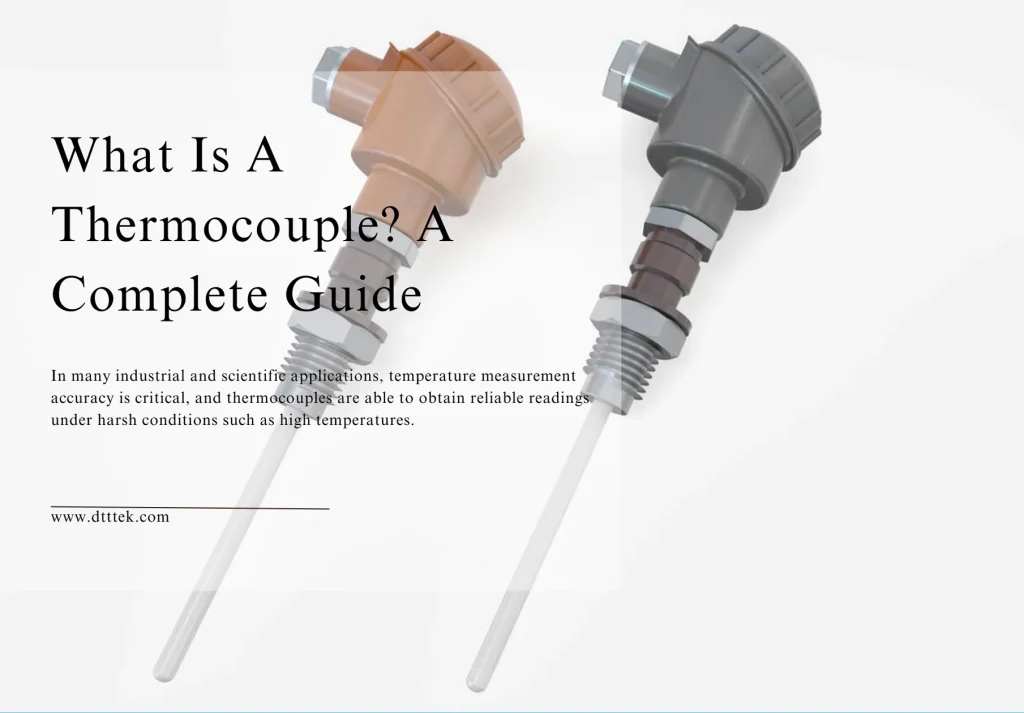
So what is a thermocouple? It is a component used to measure temperature. In many industrial and scientific applications, temperature measurement accuracy is critical, and thermocouples are able to obtain reliable readings under harsh conditions such as high temperatures. Although the thermocouple is simple in structure, it uses complex physical principles to achieve accurate temperature monitoring in a variety of environments.
Read on to discover the science behind thermocouples, explore their common types, learn about their applications in high-temperature and food industries, and understand how they compare to other temperature sensors like thermistors and RTDs. This article will also guide you through best practices for choosing and maintaining thermocouples to optimize performance.
What Is A Thermocouple?
A thermocouple is a temperature sensor consisting of two dissimilar metal wires joined at one end to form a measuring junction. When this junction experiences a temperature difference relative to the other ends (reference junction), it generates a small voltage proportional to that difference. This voltage can be interpreted to determine the temperature at the measuring junction.
Thermocouples are prized for their rugged construction, their ability to measure extremely high or low temperatures, and their self-powered nature, as they require no external power source. Because of their versatility, they are ubiquitous in industrial, scientific, and commercial temperature measurement applications.
How Does A Thermocouple Work?
Thermocouples operate based on the Seebeck effect: when two different metals form a closed circuit and there is a temperature difference between the junctions, a voltage (electromotive force) is produced. This voltage is directly related to the temperature difference.
Key components and principles:
- Hot junction: The point where the two metals are joined and exposed to the temperature to be measured.
- Cold junction (reference junction): The other ends of the wires, maintained at a known temperature.
- Voltage generation: The temperature difference between hot and cold junctions produces a measurable voltage.
- No external power: The thermocouple generates its own electrical signal.
What Are Main Types of Thermocouple?
Each type has unique advantages depending on temperature range, environment, and accuracy requirements.
| Type | Composition | Temperature Range (°C) | Characteristics | Typical Applications |
| K | Chromel (+) / Alumel (-) | -200 to 1260 | Most common, good oxidation resistance | General industrial, HVAC, kilns |
| J | Iron (+) / Constantan (-) | -40 to 750 | Suitable for reducing atmospheres | Older equipment, metallurgy |
| E | Chromel (+) / Constantan (-) | -200 to 900 | High output voltage, sensitive | Cryogenics, oxidizing environments |
| F | Iron (+) / Constantan (-) | Up to ~750 | Similar to J, less common | Specific industrial uses |
| N | Nicrosil / Nisil | -200 to 1300 | Stable at high temperatures | Nuclear, aerospace |
| R, S | Platinum-Rhodium alloys | Up to 1600 | High accuracy, expensive | Laboratories, high-precision work |
| T | Copper / Constantan | -200 to 350 | Good for low temperatures | Food industry, cryogenics |
Thermocouple Probe
A thermocouple probe is the assembly that houses the thermocouple wires and junction, often protected by a metal sheath. Probes can be designed for specific applications, such as insertion probes, surface probes, or immersion probes.
Where Are Thermocouples Applied?
Thermocouples are versatile sensors used in diverse fields:
High Temperature Applications
Ideal for extreme environments such as furnaces, gas turbines, and molten metal processing, thermocouples withstand temperatures that damage other sensors.
Food Industry Applications
Used for monitoring cooking, freezing, and storage temperatures, thermocouples provide fast response and durability. They are common in penetration probes and oven controls.
Industrial Environments
Widely used in petrochemical plants, refineries, HVAC systems, and automotive manufacturing, thermocouples endure harsh conditions like vibration, moisture, and chemical exposure.

Special Conditions
Thermocouples can be customized for vacuum, inert atmospheres, or corrosive environments by selecting appropriate sheath materials and junction types.
Key Benefits of Thermocouples in Applications:
- Wide temperature measurement range (-200°C to 2000°C+)
- Fast response times (milliseconds to seconds)
- Rugged and durable construction for harsh environments
- Self-powered operation, no external power needed
- Cost-effective compared to other high-temperature sensors
Thermocouple vs Other Temperature Sensors
Understanding how thermocouples compare to other sensors like thermistors and RTDs can help you select the right device.
Thermocouple vs Thermistor
- Thermocouples measure a wide temperature range (-200°C to 2000°C), are rugged, and self-powered.
- Thermistors are highly sensitive and accurate over a narrow temperature range but less durable and require external power.
- Thermistors are ideal for precise low-temperature measurements; thermocouples excel in high-temperature or harsh environments.
Thermocouple vs RTD (Resistance Temperature Detector)
- RTDs use resistance changes in metals (usually platinum) to measure temperature with high accuracy and stability.
- RTDs are more accurate but limited to lower temperatures (up to ~850°C) and are more fragile and expensive.
- Thermocouples handle higher temperatures and rough conditions but with less precision.
How To Choose The Right Thermocouple
Selecting the right thermocouple is a critical step to ensure accurate, reliable, and durable temperature measurement tailored to your specific application. Given the wide variety of thermocouple types, materials, and configurations available, making an informed choice requires evaluating several key factors.
Practical Steps to Choose the Right Thermocouple
- Define the temperature range your application requires, and select a thermocouple type that is rated for that range.
- Then, evaluate the environment for chemical exposure and mechanical stresses so that you can determine the appropriate sheath and wire materials.
- Decide on the probe configuration—whether immersion, surface, or penetration—and the junction type, based on your installation needs.
- Check instrument compatibility including connectors and compensating cables.
- Consider accuracy and calibration requirements to select a thermocouple with suitable tolerances.
- Balance cost and maintenance factors to ensure long-term reliability and minimal downtime.
Installation and Maintenance Tips
Proper installation and regular maintenance are essential to ensure that thermocouples provide accurate, reliable, and long-lasting temperature measurements. To support this, below are detailed guidelines as well as best practices, derived from industry standards and expert recommendations.
Installation Tips of Thermocouple
Correct installation maximizes thermocouple performance by minimizing errors such as stem conduction, thermal lag, and electrical noise.
- Select Proper Location and Insertion Depth:
Choose a location where the temperature is representative of the process, avoiding stagnant zones or areas with temperature gradients. - Use Appropriate Mounting Methods:
Thermocouples can be mounted via compression fittings, threaded connections (e.g., 1/2” NPT), thermowells, or surface mounts with adhesives or screws. For high-temperature or harsh environments, use robust fittings and protective sheaths to prevent mechanical damage. - Avoid Direct Flame or Heat Impingement:
Do not expose the thermocouple sheath directly to flames or localized heat sources, as this can damage the sensor and cause inaccurate readings. - Use Correct Extension Wire and Connectors:
Always use extension wire that matches the thermocouple type to avoid introducing measurement errors.
Maintenance Tips of Thermocouple
Regular maintenance ensures thermocouples remain accurate and functional over time, preventing costly downtime and process disruptions.
- Routine Inspection and Cleaning:
Perform monthly inspections for base metal thermocouples, although the frequency may need to increase depending on process conditions. Gently clean thermocouple tips with a soft brush or compressed air to remove dust and debris. If corrosion is present, carefully use fine abrasive materials like sandpaper, and then follow up with thorough cleaning.
- Check for Physical Damage:Inspect for signs of wear, oxidation, or sheath damage. Replace thermocouples with burned-out or contaminated protective tubes to avoid erroneous readings.
- Maintain Stable Insertion Depth:When reinserting thermocouples, ensure the insertion depth remains consistent. Changes can cause thermal lag and measurement errors.
- Calibrate Periodically:Thermocouples can drift over time due to contamination or alloy degradation, especially at elevated temperatures. Periodic recalibration is recommended to maintain accuracy, particularly in critical applications.
Conclusão
Thermocouples are versatile, rugged, and cost-effective temperature sensors that operate on the Seebeck effect, generating a voltage proportional to temperature differences. Their wide range of types and configurations allows them to measure temperatures from cryogenic lows to extreme highs, making them indispensable in industrial, scientific, and food processing applications. Understanding thermocouple types, applications, and installation best practices ensures accurate and reliable temperature measurement.
The global thermocouple market was valued at approximately USD 703 million in 2021 and is projected to reach USD 926 million by 2029, growing at a CAGR of 3.5%. This growth is driven by increasing industrial automation, expanding applications in automotive and food industries, and rising demand for precise temperature control in manufacturing processes. North America currently dominates the market, while Asia-Pacific is the fastest-growing region due to rapid industrialization and technological adoption.
If you’re looking for a reliable temperature measurement solution, DTTTEK can provide a team of experts and specialized solutions to help you obtain high quality thermocouples and comprehensive technical support. Our range of thermocouples can be viewed via email or form. Or if you have any further questions, just contact us.

 Português do Brasil
  English
  Español
  العربية
  Deutsch
  한국어
한국어