


Índice
Have you ever wondered why in many industries like healthcare and manufacturing, things get done with precision? How is everything in healthcare temperature is measured with perfection and how manufacturers build large quantity of products without any flaws? The answer behind this is precise temperature control.
For this temperature control, these industries rely on devices like RTDs (resistance temperature detectors), which work as highly accurate and reliable temperature sensors. Unlike some other types of sensors, like thermocouples and thermistors, RTDs are known for better stability, repeatability, and accuracy.
But this has probably already left you thinking, what actually is an RTD? If yes, then read on because this article will cover everything from what an RTD is, its types, common applications, and selection criteria to choose the right one for your needs.
What is an RTD Temperature Sensor?
In simple words, RTD is a sensor that uses the principle of a metal’s resistance changing predictably with temperature. Most commonly, these RTD devices are made from platinum (Pt100 or Pt1000), which offers high stability and accuracy.

How RTD Temperature Sensor Trabalhar?
These detectors operate on the principle that a metal’s electrical resistance increases with temperature. This change in resistance is then measured and converted into temperature using calibration or equation tables. For instance, a Pt100 sensor has a resistance of 100 ohms at 0°C, and it increases approximately 0.385 ohms/°C.
Key Characteristics
Some key characteristics that these detectors are known for are:
- High Accuracy:Typically ±0.1°C to ±0.5°C
- Excellent Stability:Long-term drift is minimal
- Repeatability: High measurement consistency
- Wide Temperature Range: -200°C to +850°C
- Linearity: Better than thermocouples
Types of RTD Temperature Sensors
Every industry has different temperature measurement needs, and therefore, one device can’t fulfill all the needs. This is why we get RTDs in different configurations and constructions, and each comes with its unique features to fit specific application needs. Here are some common types of RTDs:
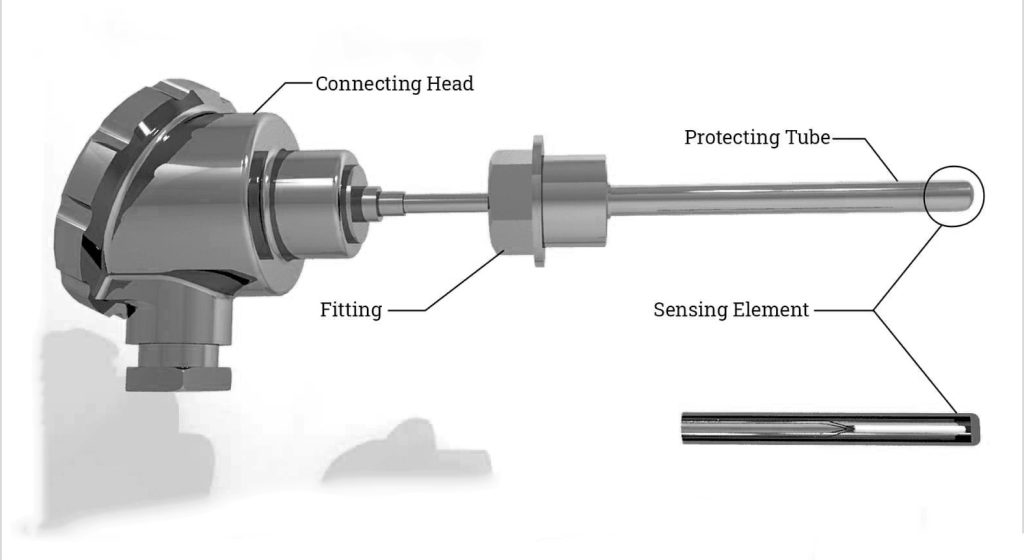
2-Wire RTD
The 2-wire is the most basic and economical configuration. Just like the name suggests, it uses two wires to connect the sensor element to the measuring device. This makes it simple but also less accurate at long distances because of lead wire resistance.
Características
- Cost effective
- Simplest wiring configuration
- Easier installation
- Compatible with standard monitoring equipment
Benefits
- It’s best for applications where the wiring length is minimal
- Saves space and reduces the wiring complexity
- Good choice for basic temperature monitoring
3-Wire RTD
The 3-wired RTD is the most common solution in industrial settings. In this, a third wire is introduced, which helps compensate for the resistance of the lead wires. It is the perfect balance between cost and improved measurement accuracy.
Características
- Compensates for lead wire resistance
- Balanced bridge circuit setup
- Available in various probe and sheath styles
- More reliable over medium-length cable runs
Benefits
- Better accuracy than 2-wire
- Ideal for industrial applications
- Easy integration into PLCs and temperature monitoring devices
- Greater confidence in process measurements without high cost
4-Wire RTD
The 4-wire now stands above both the 3-wire and 2-wire because it completely eliminates the influence of lead wire resistance. This configuration is the best choice for applications that demand extreme measurements.
Características
- No lead wire resistance errors
- Excellent linearity and repeatability
- Supports long-distance installations without affecting accuracy
- Highest signal integrity among all wiring types
Benefits
- Superior accuracy for calibration labs, R&D, and sensitive environments
- Essential for precision-critical processes like pharmaceutical, manufacturing, and aerospace
- Maintains performance even with long cable lengths or environmental noise
- Allows system designers to meet tight regulatory requirements
Thin-Film RTD and Wire-Wound RTD
Beyond the wiring configurations, these RTDs also vary by their construction type. The two common forms of this are thin-film and wire-wound RTDs. Each has its different mechanical properties and performance characteristics.

Thin-Film RTD
These detectors are made by depositing a platinum film onto a ceramic substrate. They are ideal choices for environments where space is constrained or for surface measurement applications.
Características
- Compact and low-profile design
- Fast thermal response time
- Lower manufacturing cost
- Available in chip or flat-surface formats
Benefits
- Best for electronics, automotive, and compact consumer applications
- Suitable for rapid thermal cycling environments
- Great for surface temperature monitoring or embedded designs
- Cost-effective for high-volume manufacturing
Wire-wound RTD
Wire-wound RTDs are constructed by winding a fine platinum wire around the ceramic or glass core. Therefore, they work efficiently even in high-temperature environments.
Características
- Higher thermal stability and mechanical strength
- Excellent long-term drift characteristics
- Wide operating temperature range
- Superior repeatability over long-term use
Benefits
- Ideal for temperature industrial process (up to 850°C)
- Best choice for applications requiring high reliability and consistency
- Suitable for harsh environments and extended use cycles
- Highly accurate data for quality control or scientific analysis
How to Use RTD Temperature Sensors?
Now that we have learned their benefits and explored different types, the next question is how to actually use them? However, this isn’t something complicated to do if you know the right steps. Scroll down to uncover everything from installing and wiring to applying these RTDs in various fields.
Step-by-step Installation Guide
Here are all the steps for a seamless installation:
- Choose appropriate sensor type and configuration
- Mount the sensor securely in the measurement environment
- Ensure good thermal contact with the measured surface or fluid
- Use compatible connectors and enclosures for protection
Wiring and Calibration
Here are some tips for proper wiring and calibration:
- Use color-coded wires for correct connections
- Calibrate using standard resistance tables (e.g., ITS-90 for Pt100)
- Validate readings using a reference thermometer
Common Applications
These detectors are built for versatility, and therefore, they are used in a wide range of industries where temperature control and monitoring are critical. Below are some fields where RTDs play an important role.
Industrial Applications
In industrial environments, RTDs are highly useful as they are used in control systems, power plants, chemical processing units, and manufacturing lines. The precision and durability they provide are best for monitoring turbines, motors, boilers, and HVAC systems. The use of RTDs here can also improve operational safety, reduce energy consumption, and maintain product quality.
Medical Applications
Medical devices can only ensure patient safety and effective diagnostics when they can provide accurate and responsive temperature measurement. RTDs can help with this and are used in incubators, sterilizers, dialysis machines, and other patient monitoring systems. Thus, the role of RTDs can ensure precise control in life-critical conditions.
Consumer Applications
RTDs are also integrated into the consumer electronics and appliance industries. They are found in the products that are part of our everyday life like coffee makers, ovens, washing machines, and HVAC controls. Thanks to their compact size and fast response, this makes they are suitable for smart home devices.
Food and Beverage
The food and beverage industry must comply with hygiene standards and provide consistent food quality. However, this isn’t possible without proper temperature measurement. This is why RTDs are also utilized here, specifically in cooking processes, cold storage, and brewing.
RTD Application Comparison Table
Here is a table of applications to help you better understand the use of RTDs in different fields.
| Industry | Common Uses | Key Benefits | Sensor Requirements |
| Industrial | Boilers, motors, process lines, and HVAC systems | High accuracy, reliability, long-term stability | Rugged construction, high temperature range |
| Medical | Incubators, sterilizers, patient monitoring | Safety-critical precision, fast response time | Biocompatibility, small size, and high accuracy |
| Consumer | Applications, HVAC, smart home systems | Compact design, energy efficiency, cost-effectiveness | Fast-response, spacing-saving form factors |
| Food & Beverage | Cooking, refrigeration, pasteurization, brewing | Hygiene compliance, consistency, regulatory standards | Hygienic enclosures, corrosion resistance |
Tips for RTD Temperature Sensors Maintenance
Just like every device requires maintenance for optimal performance, RTD sensors are no different. With proper maintenance, you can extend the life and maintain the accuracy of these detectors. Here are some tips to do this properly.
Calibration and Testing
- Period calibration can ensure high accuracy, and the recommended period is every 6 – 12 months
- Use certified calibration equipment
Cleaning and Storage
- Clean with Isopropyl alcohol or other appropriate solvents
- Store it in a dry and static-free environment to prevent damage
Troubleshooting Common Issues
- Fluctuating Readings:Check for poor connections or interference
- Sensor Drift:Recalibrate or replace the sensor
- No Reading:Inspect wiring continuity or sensor damage
Factors to Consider When Choosing an RTD Sensor
You can’t just choose any type of RTD sensor because each type is built for different environments. Choosing the right one is important to ensure optimal performance in your application. Below are some factors you can consider to make the right choice.
Faixa de temperatura
Every sensor is designed to operate within a specific temperature range. This is why selecting, make sure to match the sensor’s capabilities with temperature extremes of your application. The standard platinum RTDs (like PT100) typically cover a range of -200°C to +850°C, but certain applications may require narrower or broader ranges. Make sure not to overstep these limits because it leads to sensor failure.
Accuracy and Precision Requirements
Different RTDs vary from one another in terms of accuracy. RTD sensors are classified by tolerance classes like Class A, B, or 1/10 DIN, and Class A is considered more precise. Wiring configuration also influenced accuracy, and 4-wire systems offer the highest measurement accuracy. Here are the accuracy values of different classes:
- Class A: ±0.15°C at 0°C
- Class B: ±0.3°C at 0°C 1/10
- DIN: ±0.03°C at 0°C
If you choosing it for quality-sensitive applications, then go for Class A or 1/10 DIN RTDs.
Environmental Conditions and Durability
Environment is another important factor to consider because it can impact the sensor’s performance. Do not forget factors like humidity, chemical exposure, medical vibration, or pressure. Protective sheaths, special coatings, or stainless steel housings are required for rugged environments.
Examples:
- High-Moisture Areas:Use sealed or encapsulated sensors
- Corrosive Environments:Choose PTFE or stainless-steel covered RTDs
- Vibration Zones:Use spring-loaded or armored probes
Response Time and Sensor Size
The response time means how quickly the RTD reacts to the temperature changes. This is very important in dynamic systems where real-time data is crucial. There are various things that influence the response time, such as sensor size, tip design, and construction material.
Typical Response Time:
- Thin-Film RTDs: ~1-3 seconds
- Wire-Wound RTDs: ~3-8 seconds
For rapid thermal cycling, you can choose a smaller and faster responding sensor or a larger probe for stable environments.
Conclusão
Certain applications without proper temperature measurement can cause various problems. Fortunately, with the help of RTDs, you can get reliable temperature measurements in a wide range of applications. Also, with various configurations like 2-wire, 3-wire, 4-wire, thin-film, and wire-round, users can easily match the sensor performance with application needs.
For every field, a certain type of RTD sensor may be right. Whether your needs are for food safety, industrial automation, or medical diagnostics, make sure to understand both technical specifications and application environments. You can weigh the factors that we discussed above to make a cost-effective and reliable choice.
Despite the type of RTD you choose, never compromise on the built quality of the sensor. We at DTTTEK are known for our reliable and high-quality temperature solutions. Whether your needs are for healthcare, industrial settings, or manufacturing, we can provide tailored solutions for different environments. Feel free to contact us today or explore our wide range of temperature sensing solutions online.

 Português do Brasil
  English
  Español
  العربية
  Deutsch
  한국어
한국어